
The term Forward Deployed Engineer (FDE) was coined more than a decade ago. Yet, it has taken the IT world by storm only a few years ago—about the same time GenAI entered the scene. No surprise: emerging AI has changed what enterprise clients actually need and expect from a modern software company.
For many CTOs, CIOs, or Leads who carry the weight of justifying AI spend and making AI work, a forward deployed engineering model could be a single best solution to deliver on the promise.
What is a forward deployed engineering model?
FDE has its roots in military lingo. A forward deployed engineer is embedded directly into the client’s environment to work “in the field” and deal with some of the most complex tasks the enterprise is facing. The scope may stretch from setting up critical infrastructure to preparing a scale-up for a running solution or a major legacy migration project.
No matter the scope, an FDE’s job is to find a working solution to a painful, often expensive problem that no one else in the organization can solve or has the bandwidth to take on.
Once the solution is there and proves it works, the FDE puts it into production and transfers knowledge to the in-house team. This way both the hands-on work on site and the long-term improvement of the solution are handled by a single entity: an FDE.
The FDE model isn't exactly new. But it became urgent once traditional roles had to evolve following the growing pressure of “too many pilots, not enough profit production.”
How does forward deployed engineering work?
Unlike dedicated team projects that require lengthy onboarding, forward deployed engineering engagement starts fast and runs even faster.
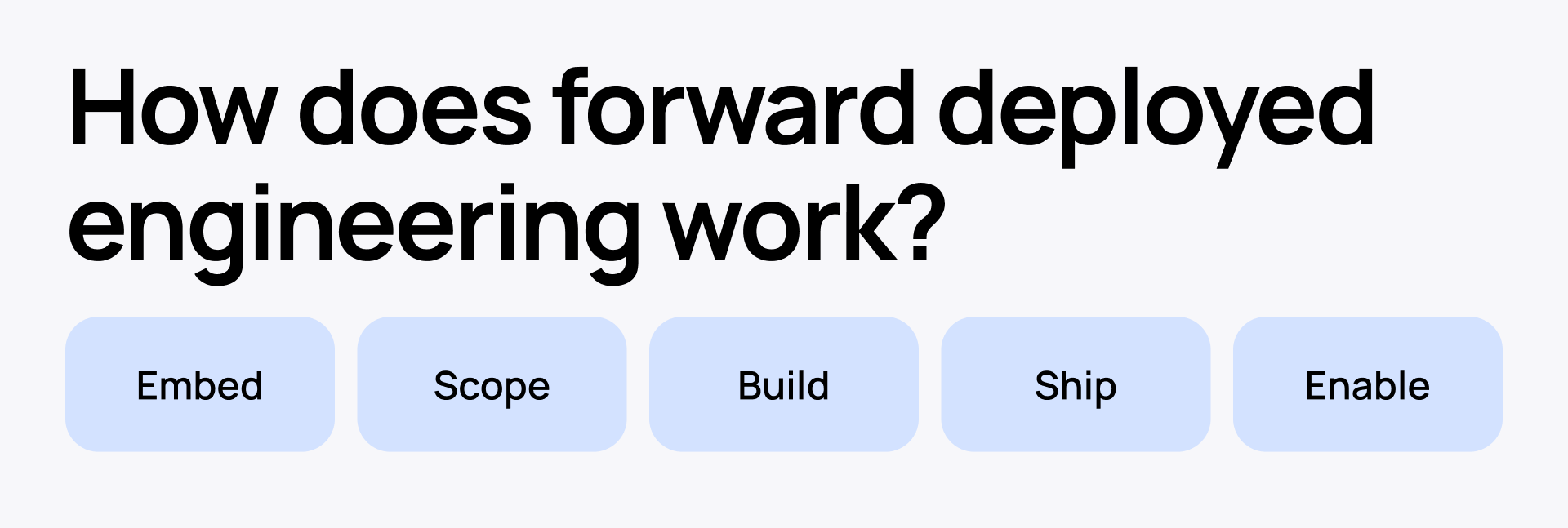
- Embed. An FDE is deployed to your environment and gets up to speed. At this stage, the FDE needs to get to the bottom of the problem with all means available: run a tech audit, gather domain and business knowledge, interview teams and stakeholders, map connections and dependencies.
- Scope. FDEs often have no specifications, requirements, or even a defined problem to work with. Only a goal. So they build their own scope and steer it on the go to make sure what was promised will be delivered within the given timeline.
- Build. This is when actual hands-on work happens. Unlike a consultant or an architect who can only propose a solution, an FDE builds it, working within your actual environment against your real infrastructure and constraints.
- Ship. An FDE deploys the solution in production and embeds it in your systems and workflows.
- Enable. An FDE transfers knowledge and ownership back to your team. This is perhaps the best part of the forward deployed engineering model: an FDE is never meant to be a permanent dependency.
Engagement ends when it hits the goal set at the beginning, e.g., KPI reached, migration complete, or AI solution up and running in production.
One more thing worth mentioning: an FDE doesn’t necessarily work alone. Depending on the scope, a single dedicated engineer can be embedded full-time, while a small cross-functional team (an AI engineer, UX/UI designer, or a DevOps) supports the FDE on the ground.
Either way, an FDE usually remains the main point of contact and the sole owner accountable for the outcome.
What does a forward deployed engineer do?
With great power comes great responsibility. Being the primary owner and single point of contact for all tracks is not for everyone. Just like in the military, it takes a special mind to be able to work under pressure, stay on time, and make sure the solution built won’t turn out to be a bigger problem in the long run.
The FDE’s task is not just to solve the problem, but to make sure they are actually working on the REAL problem. They juggle C-level meetings with technical deep dives, build IT frameworks that will drive billion-dollar companies for years to come. And this is just an ordinary Tuesday.
One example is Databricks FDEs—currently one of the most elite groups of highly trained IT specialists in the market. To join this Special Forces group, engineers have to have many hats ready in their inventory.
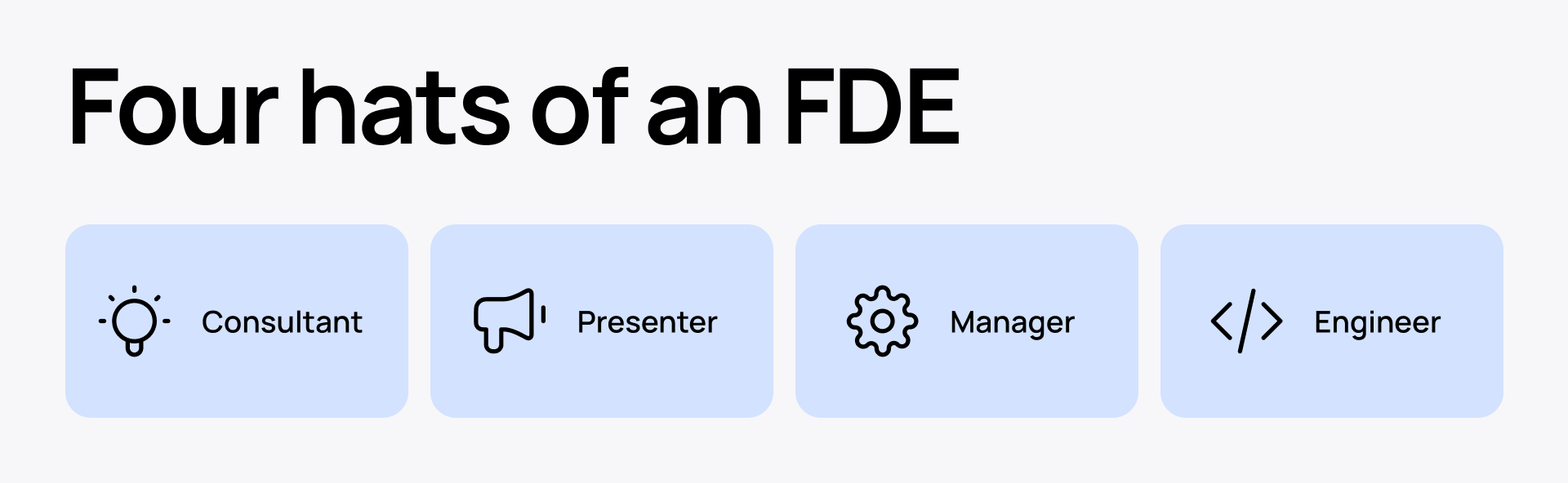
Hat No 1: Consultant
Clients want things. They can often articulate their needs. But this should rarely be taken at face value. Not because the client is wrong, but because they rarely know what exactly they need. Otherwise, they would have done it already.
The gap between the original brief and the actual scope is the most critical phase. This is the time when an FDE has a chance to uncover the real need and propose solutions that will actually address this need in earnest.
The client may not like the changes. They may want to move forward with what management asked to deliver originally. The FDE’s responsibility is to discover what the real problem is and convince the organization to focus on that—for a bigger impact is a critical one.
Without this, an FDE is just a good engineer.
Hat No 2: Presenter
Big solutions require big fights. These fights are not always direct. Sometimes the pushback hides behind nodding heads or polite promises.
Forward deployed engineering requires not just finding a solution, but selling it back to the client. This requires an entirely different set of skills: to speak, present, persuade, and build genuine trust. Having these skills directly impacts whether or not an FDE has a chance to deliver something meaningful.
Without this, an FDE is just another voice in the wind.
Hat No 3: Manager
Some FDE days feel impossible—a stakeholder interview, a tech deep dive, a debriefing with the product team, two critical tasks on the to-do list. And that’s just one morning. When projects ramp up, or in a critical phase (they pretty much always are), an FDE is overwhelmed and has to prioritize among already top priorities.
FDEs are good at it and find ways to make everything work on time and focus on what is actually critical at a given moment. This ability to do magic when it comes to juggling tasks and managing conflicting priorities sets FDEs apart and makes them the cornerstone within the client organization.
“He is always ready to help me in meaningful ways” is the correct feedback for an FDE.
Without this, an FDE is just one more person on the team, who may fail to meet a deadline and therefore is not reliable.
Hat No 4: Engineer
Once the project governance, rescoping, reporting structures, and endless kickoff meetings are behind, FDEs can actually get to do the job they were hired for.
They tackle engineering and architecture problems far too difficult for the rest of the staff. They make fast decisions that would normally fall under CDO jurisdiction. And they make it work in the end, even better than the client expected—leading to a quick promotion for the client and a solid reputation for the FDE’s parent company.
All that is possible thanks to relevant technical skills, rich experience, and the ability to keep the big picture in mind. Plus, the impeccable delivery skills that set FDEs apart from the horde of average engineers.
Without this, an FDE is just a big mouth who can't deliver on what they promised.
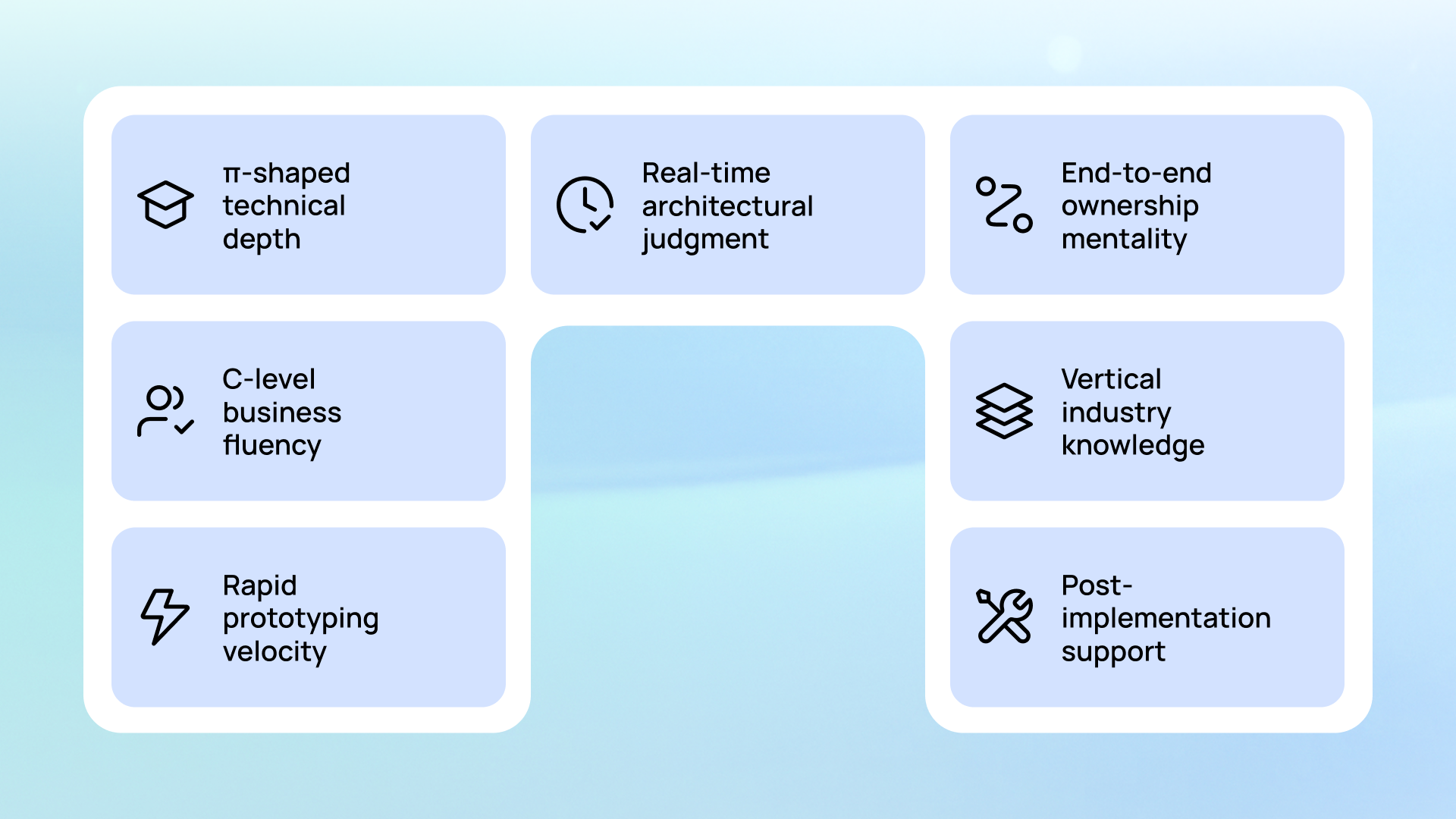
To wear all these hats, an FDE needs to have:
- π-shaped technical depth with strong expertise in 2-3 domains (e.g., data science, AI, software engineering).
- End-to-end ownership mentality and personal accountability for the result.
- Real-time architectural judgment and ability to make design decisions on the spot.
- C-level fluency to turn business goals into technical specifications, then communicate them back to the room of non-tech stakeholders.
- Speed to build prototypes and PoCs in days or even hours, then move to production in weeks.
- Vertical industry knowledge or ability to quickly get up to speed in a new domain or niche.
- Enablement mindset: not only build and integrate, but also support what’s delivered and make sure it scales.
Top capabilities of a forward deployed engineer
When do you actually need an FDE?
Forward deployed engineering blends the role of a consultant, architect, and engineer with solid people skills. But FDE is not for everyone, and not every company needs one. In fact, there are very specific use cases when the FDE model is the right fit.
Main FDE promise: Tell us what you’re struggling with. We will get to the bottom of the problem, find a solution, and make it work.
Use case 1: Pilots multiply, nothing goes to production
Pilot purgatory hasn’t gone anywhere. In 2025, nearly half (42%) of organizations abandoned their AI initiatives, according to the S&P Global survey. In 2024, it was only 17%.
PoCs are built, budgets are spent, but nothing goes live. Forward deployed engineering model has been gaining traction in part to address this exact problem. Because the main goal of an FDE is not just to figure out how to solve the problem and pilot it to the board, but to build a practical solution and get it to work.
Use case 2: Business problem no one can figure out
Business understanding is one of the core skills of an FDE. Different stakeholders see the same problem from different angles, and therefore no one can fully articulate it, let alone find a solution. The goal of an FDE is to close this gap.
Use case 3: Tech problem beyond in-house competence
This is perhaps the most straightforward use case. Sometimes, an organization simply doesn’t have the right tech skills to not only solve the problem, but to own the entire process from gathering requirements to putting everything into production. This is where the FDE’s π-shaped technical depth comes into play.
How do enterprises win with FDEs?
Yes, but at what cost? On average, getting an FDE on the project is around 20%-30% more expensive compared to hiring a seasoned senior engineer. Despite higher rates, however, the benefit-cost ratio of forward deployed engineering services justifies the investment. For several reasons:
- Resolved management throughput. FDE finally takes action and solves the expensive problem no one else in the organization had time to deal with in the first place.
- Assumed responsibility. FDE takes on the hardest part: ownership and accountability for the result. Managers reap the rewards: solve a painful problem and get promoted by the end of next quarter.
- Justified AI spend and PoC costs. If the pilot never moves to production, it remains an expensive experiment that burns tokens, drains AI budgets, and dissolves the board’s trust.
- Faster speed to production. Along with the tech depth and practical engineering experience, FDEs bring to the table tons of savings opportunities for faster builds: reusable boilerplates, blueprints, and patterns already proven in production.
- Reduced technical debt. Often underestimated, technical debt can sink the best of the ideas just by rendering them impossible because of a half-baked design solution or lack of architectural elasticity. FDE builds with scalability in mind from day one.
Afterthought
As I already mentioned, forward deployed engineering model is not for everyone. And not every project needs an FDE. If you have a well-scoped project with clear specifications, a dedicated team is often the right fit for reliable delivery. If you have a running project and only need extra hands to handle the scale, team augmentation is enough.
However, if you have a painful business or tech problem but neither the bandwidth nor the in-house competence needed for the job, consider hiring a forward deployed engineer.